

Online · Côte d’Ivoire
Masterclass on the internet and the web
I hosted a Masterclass with the theme: Understanding the internet and the web
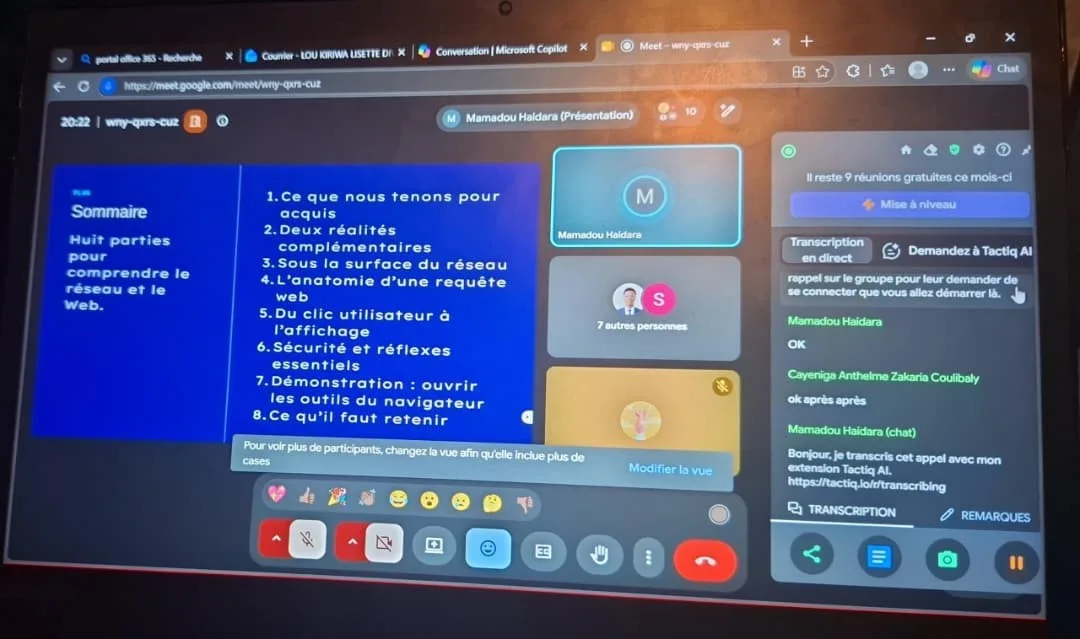
Understanding the Internet and the Web: a look back at an experience of sharing and transmission
On November 1, 2026, I had the opportunity to host an online Masterclass on a subject that we use almost every day, but whose mechanisms we do not always know: the Internet and the Web.
The idea behind this meeting was quite simple: not to limit ourselves to explaining how to use the Internet, but to allow participants to understand what is actually happening when they open their browser and visit a website. I also wanted to take this opportunity to cover some digital security best practices, which are essential in our daily use of digital tools.
Going beyond what we see on the screen
To start, I chose to address a fairly common confusion: the difference between the Internet and the Web.
We tend to use these two terms as if they referred to exactly the same thing. However, they are quite different. I therefore began by presenting the Internet as a set of interconnected networks, composed in particular of terrestrial and submarine cables, routers, servers, and numerous devices that communicate with each other.
The Web, for its part, is one of the services that use this infrastructure. It allows access to pages and resources through a browser. I also mentioned the work of Tim Berners-Lee, who proposed the World Wide Web project in 1989.
After this initial distinction, we moved into the concrete functioning of the Web. This was probably one of the most interesting parts of the presentation, because it helped answer a question that many users do not necessarily ask themselves: what exactly happens when you type an address into your browser?
I took the example of a user who wants to access a website. From there, we went through the different steps: entering the URL, resolving the domain name via DNS, obtaining the server's IP address, and then sending an HTTP or HTTPS request.
I explained how data travels between the browser and the server across the network, particularly through packet transmission mechanisms. We also discussed the role of HTTP and HTTPS protocols, emphasizing the importance of TLS encryption to secure communications.
My goal was to make this process understandable without losing sight of its technical reality. It was not enough to just give definitions: it was above all necessary to allow participants to visualize the different steps and understand the role of each element.
When explanations become concrete
To prevent the presentation from remaining purely theoretical, I devoted part of the session to a practical demonstration.
I opened the browser's developer tools using the F12 key. This was an opportunity to show participants what is really hidden behind a web page that we usually browse without asking questions.
We observed the different resources loaded by the browser: HTML, CSS, and JavaScript files, images, and other elements necessary for displaying a page.
I took the opportunity to recall the role of these three fundamental web development technologies. HTML defines the structure of the page, CSS handles its appearance, and JavaScript allows for adding behaviors and interactions.
We also looked at server responses and HTTP status codes. The 200 code, for example, indicates that a request has been processed successfully.
This demonstration was particularly important to me. I wanted the participants to be able to concretely observe certain mechanisms we had just talked about, rather than just imagining them. Seeing the resources appear in the developer tools makes it easier to understand the work done in the background when a site loads.
The Internet is not just about its technical functioning
After exploring the mechanisms of the Web, I steered the presentation toward another equally important aspect: our online security.
Understanding the Internet also means learning to use it better and recognizing certain risks. I therefore shared several simple recommendations that everyone can apply on a daily basis.
We talked in particular about the importance of checking site addresses before sharing personal information. I used the examples of jumia.ci and jumia.com to illustrate the need to pay attention to domain names and the spelling of URLs.
I also insisted on using different passwords for each service, the value of password managers, and enabling two-factor authentication when available.
Other habits were discussed, including regular updates of systems and applications, caution regarding messages that seek to create a sense of urgency, and verifying sources before clicking on a link or downloading a file.
Another important point concerned HTTPS. I reminded everyone that this protocol helps secure exchanges through encryption, but that a secure connection does not necessarily mean that the site visited is trustworthy.
The idea was to show that digital security does not depend solely on the tools used. It also relies on the reflexes and decisions we make every day.
Participants' questions, an important moment of the meeting
The Q&A session allowed us to revisit several concepts and delve deeper into certain points.
Divine, in particular, wanted to understand more precisely what happens when a user enters an address into their browser. We went over the path of a request together, from the resolution of the domain name to the receipt of the resources necessary for displaying the page.
She also raised an interesting question: what is the real difference between Google Chrome and the Internet?
I explained that Chrome is an application, more precisely a browser, which allows access to resources available on the Web. The Internet, on the other hand, represents the network infrastructure that makes these communications possible. In other words, Chrome uses the Internet, but it does not constitute the Internet.
Thiegnon, for his part, asked for clarifications on HTTP and HTTPS. We went back over their role in exchanges between a client and a server, as well as the additional protection provided by HTTPS through TLS encryption.
These interventions were useful, as they allowed us to revisit concepts that might have seemed abstract at first. They also gave me the opportunity to rephrase certain explanations and start from the participants' concrete concerns.
Beyond the technical questions, I appreciated the opportunity to interact directly with the participants and see their interest in the topics covered.
What I take away from this experience
Reflecting on this meeting, I take away above all the importance of knowledge transmission.
As technology and development enthusiasts, we sometimes tend to consider certain concepts as obvious. However, mechanisms that we use daily can remain difficult to understand for other people.
This Masterclass reminded me that mastering a subject is not enough to be able to teach it. You have to know how to choose the right examples, adapt your vocabulary, illustrate your explanations, and above all take the time to answer questions.
The practical demonstration also reinforced my idea that a good explanation often benefits from being accompanied by a concrete illustration. Showing what happens behind the scenes of a website helps give meaning to concepts that might otherwise remain theoretical.
I sincerely thank Divine, Cheick, Thiegnon, and all the participants for their presence and their participation in the discussions.
This experience reinforces my conviction: digital technology should not be reserved for those who develop it or master it technically. It must also be explained, shared, and made accessible to as many people as possible.
Because beyond knowing how to use technology, understanding how it works allows us to better master it.